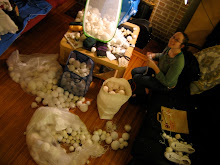
 (This is a stuffed dino-dude I made for a staff collaboration that was never completed. Which was fine by me because this guy got to hang out in my studio all session!)
My studio assistant of years past was unable to return to camp due to getting a job running costumes on the set of Conan the Barbarian in Bulgaria (seriously). So I called in my good friend Liz to fill the position:
 (Shown here holding her "worlds best liz" trophy made by artist Heather Beck.)
Liz is a spectacular fibers artist and textile designer as well as being an absolutely splendid person to teach with! We started the session with dyeing and shibori:
 (MX Chemical dyes and Indigo! Check out those sweet Arashi style, Indigo dyed t-shirts there on the end!)
After the dyeing we moved onto screen printing!
 (Miriam helping Lauren print her print exchange image: lace!)
When I was in college I always wanted to participate in the print making department's print exchanges but they seemed skeptical because I was printing fabric instead of paper. But print exchanges are awesome! So I have my students participate in our own exchange.
 (Caleb and Simon printing Caleb's Dali image.)
The assignment is to design an image to fit inside an 8" x 8" space and to print a set of those images onto dyed fabric squares measuring 10" x 10". I try to get the students to think about color, contrast, use of space, images/symbolism, text and directionality. The hope is that making a set will be enough practice with printing and registering that they will be able to print however much they'd like to for their final project.
 (Caleb, Lucie and Joni exchanging prints.)
We had a pretty good critique about the images in both my morning and afternoon class. The students, although a bit hesitant at first to talk about eachother's work, had some pretty insightful comments. Critique is something I struggle with at Snow Farm: there is so much work to do and not a lot of time for discussion. As my syllabus evolves it is another thing I'm going to designate time for.
 (Many of the prints as they were hung in the end-of-session gallery.)
The third and final project of the session is the flat-patterning and sewing of a three dimensional object or garment. Early in the first week of class we take a field trip to the local (HUGE) Salvation Army so that each student can start thinking about their final project. Then, they learn how to take their garment/object apart, lay it flat to create a pattern and then recreate the garment/object out of their own dyed and printed fabric. In the process, they also learn how to operate a sewing machine and sew a variety of seams and hems.
 (Liz with her deconstructed garment.)
This summer we had a couple of dresses, a few skirts, a painterly corset, a pair of dapper vests and an extremely awesome handbag! I'd like to see more students choose to make objects instead of garments but whatareyagonnado.
 (Joni was clever enough to pick a simple garment. Which meant that she, unlike some of the rest of us, had ample time to complete her project. Nice work, Joni!)
This is definitely the most challenging project of the session and it's a project that I think needs to either be altered a little or made the main focus of the class. I like doing the print exchange a lot but I realized this year that as that assignment has come into it's own more, the garment construction has lost a little bit of time. Which ends up meaning that many students don't have enough time to finish their projects.... which is a bummer. Next summer I hope to have a set of assignments that fit better into the two week period.
 (World's Best Liz demonstrating the Map Project.)
I love fiber art for a lot of reasons but one of the biggest is that it inherently carries with it history, culture and the weight of global economies. For that reason, I try to infuse my classes with discussions about textile history as well as the ramifications of a fashion-based culture that treats cloth as something that comes from H&M and can be disposed of as soon as the season changes. Which is false! Cloth goes through so many process to get from the plant or animal to the clothes we buy for super cheap and there are hundreds of individuals and environmentally detrimental steps in between!
Last year I started a project to initiate conversation along these lines: I bought a huge world map and, at the beginning of class, had each student place a pin into the country that produced the garments they were wearing.
Last year I started a project to initiate conversation along these lines: I bought a huge world map and, at the beginning of class, had each student place a pin into the country that produced the garments they were wearing.
 (The morning class "mapping their clothes:" Ronni, Sarah, Rachael, Miriam, Lauren.)
The project helps to remind us that the things we take for granted come from somewhere real. It also acts as a great geography review: I have to admit that even I had to google a couple of the countries/regions that produced our clothes! But seriously... highschoolers should know where Nicaragua is. (They do now: lots of pins in Central America.)

 (Not so many pins in the US.. but thanks to American Apparel we got a bunch sticking out of LA.)

I love teaching... but I also really love the all-camp field trip! This summer we went to local glass artist Josh Simpson's studio:

... and then we went to MassMOCA which is one of my favorite art museums ever!
From the Material World: Sculpture to Environment exhibit:
 Tobias Putrih, Re-projection: Hoosac, 2010.
 Orly Genger, Bog Boss, 2009-2010

(Actually... a detail shot of the piece next to the window. I really liked how the textures of the sculpture and the space related to one another.)


MassMOCA is semi-permanent home to the largest collection of Sol Lewitt wall drawings in the world! They installed it last year in it's own wing of the spacious museum:


It's pretty amazing. If you get a chance: go!
Back at camp... Snow Farm theme nights are some of the best. This year? Pirates!
 (Arrrrrgh, mateys!)
 (So goooooood.)
 (The piratey staff of first session, 2010.)
 (Arrrrrrt camp? Pirate camp!)
And as always, the end of the session brought on a flurry of last minute staff screen printing! It's secretly my favorite part of the session: staff members bring clothes to print on and we have a farmhouse printing party all night long! I think we counted around 40 printed garments in one night this year!

 (Me, Rumi and an armload of t-shirts.)
I am so lucky to have found such an amazing place to return to every summer and reconnect with smart, funny, supportive artists. I have a lot of friends in my life in the city(ies) but for some reason spending two weeks in the woods with the Snow Farm staff recharges my battery: I leave feeling motivated and excited and capable. Which is sooo important to me seeing as, for some reason, I also always seem to leave Snow Farm in some state of homelessness. This year, having just moved to Chicago and feeling a little nervous about it, Snow Farm was especially reassuring. It felt like home. :0)
Thanks, Snow Farm, for another amazing summer!




.JPG)


